
Learn the essential techniques jazz pianists use to create walking bass lines in real time
Whether you're just starting or you already play walking bass lines with your left hand, this four-step method should help you create impressive-sounding walking bass lines.
Jazz pianists who play swing music often use walking bass lines similar to what a swing bassist does, whether they play solo or with a singer or instrumentalist.
I recommend you watch the short video where I explain and demonstrate each of the four techniques.
After the video, you'll find notation examples from the video along with a brief explanation. ENJOY!
Technique No 1: Walking Bass with Chord Notes
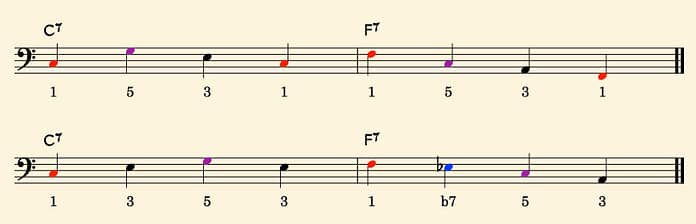
In this technique, we use only the fundamental notes of a chord. For a dominant seventh chord, these are the root, third, fifth, and flat seventh. Generally, we place the root at the beginning of the chord. The order of the other notes doesn’t really matter.
Option No 1: Roots and Fifths only
As with other music, from polka to Latin jazz, the fifth is the next important note for the bass player after the root. Here is an example of a walking bass line using only roots and fifths of each chord:

Option No 2: Roots, Fifths, thirds and Sevenths
Here, the bass plays the basic chord's notes, providing the listener with a clear understanding of each chord’s quality, even without an instrument like the piano or guitar.
Technique No 2: Stepwise Motion
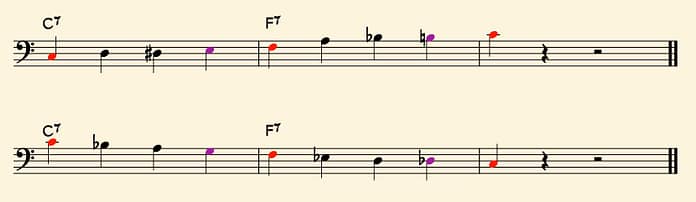
This technique involves approaching the root of the next chord by a combination of whole and half-steps instead of just chord notes. Sometimes we need to add a larger interval; it depends on how much space and how many notes we have available to move from one root to the next. Most bass players also use the so-called chromatic approach, which means approaching the root of the next chord by a half-step. This just seems to sound most convincing.
Here are two examples of how we can approach the F7 in our C Blues using this idea.